在使用多进程和多线程混合编程时会遇到很多坑,这里通过示例进行阐述,并从内核角度分析其原理。这里说的多进程多线程并不是单一的多进程或多线程,而是多进程和多线程,往往会在写一个大型应用时才会用到多进程多线程的模型。
这是怎么样的一个坑呢?假设有下面的代码:
#include <pthread.h>
#include <stdio.h>
#include <time.h>
#include <unistd.h>

void* sub_pthread(void* arg) {
    printf("ID %d: in sub_pthread\n", getpid());
    sleep(1);
    return NULL;
}

int main(int argc, char* argv[]) {
    int pid;
    pthread_t t1;
    pthread_create(&t1, NULL, sub_pthread, NULL);
    if ((pid = fork()) < 0) {
        printf("fork failed\n");
    } else if (pid == 0) {
        printf("ID %d: in children\n", getpid());
        while (1);
    } else {
        printf("ID %d: in father\n", getpid());
        while (1);
    }
    return 0;
}
线程函数sub_pthread会被执行多少次?线程函数打印出来的ID是父进程ID呢?还是子进程ID?还是父子进程都有?
答案是,只会执行1次,且是父进程的ID!为什么呢?
ID 1313389: in sub_pthread
ID 1313389: in father
ID 1313394: in children
^C
裤子都脱了,你就给我看这个?当然,这个没什么悬念,到目前为止还很简单。精彩的地方正式开始。
线程和fork
在已经创建了多线程的进程中调用fork创建子进程,稍不注意就会陷入死锁的尴尬局面
以下面的代码做个例子:
#include <pthread.h>
#include <stdio.h>
#include <time.h>
#include <unistd.h>

pthread_mutex_t mutex = PTHREAD_MUTEX_INITIALIZER;

void* sub_pthread(void* arg) {
    while (1) {
        pthread_mutex_lock(&mutex);
        printf("--- sub pthread lock ---\n");
        sleep(1);
        pthread_mutex_unlock(&mutex);
        printf("--- sub pthread unlock ---\n");
        sleep(1);
    }
    pthread_exit(0);
}

int main(int argc, char* argv[]) {
    int pid;
    pthread_t t1;
    pthread_create(&t1, NULL, sub_pthread, NULL);
    usleep(500);
    if ((pid = fork()) < 0) {
        printf("fork failed\n");
    } else if (pid == 0) {
        printf("children burn\n");
        fflush(stdout);
        while (1) {
            pthread_mutex_lock(&mutex);
            printf("--- children lock ---\n");
            sleep(1);
            pthread_mutex_unlock(&mutex);
            printf("--- children unlock ---\n");
            sleep(1);
        }
    } else {
        while (1) {
            pthread_mutex_lock(&mutex);
            printf("--- father lock ---\n");
            sleep(1);
            pthread_mutex_unlock(&mutex);
            printf("--- father unlock ---\n");
            sleep(1);
        }
    }
    return 0;
}
执行效果如下:
--- sub pthread lock ---
children burn
--- sub pthread unlock ---
--- father lock ---
--- father unlock ---
--- sub pthread lock ---
--- sub pthread unlock ---
--- father lock ---
--- father unlock ---
--- sub pthread lock ---
--- sub pthread unlock ---
--- father lock ---
--- father unlock ---
--- sub pthread lock ---
--- sub pthread unlock ---
--- father lock ---
^C
我们发现,子进程挂了,在打印了children burn后,没有了下文,因为在子进程获取锁的时候,死锁了!
凭什么啊?sub_pthread线程不是有释放锁么?父进程都能在线程释放后获取到锁,为什么子线程就获取不到锁呢?
在《Unix环境高级编程 第3版》的12.9章节中是这么描述的:
子进程通过继承整个地址空间的副本,还从父进程那儿继承了每个互斥量、读写锁和条件变量的状态。
如果父进程包含一个以上的线程,子进程在fork返回以后,如果紧接着不是马上调用exec的话,就需要清理锁状态。
在子进程内部,只存在一个线程,它是由父进程中调用fork的线程的副本构成的。
如果父进程中的线程占有锁,子进程将同样占有这些锁。
问题是子进程并不包含占有锁的线程的副本,所以子进程没有办法知道它占有了哪些锁、需要释放哪些锁。
......
在多线程的进程中,为了避免不一致状态的问题,POSIX.1声明,在fork返回和子进程调用其中一个exec函数之间,
子进程只能调用异步信号安全的函数。这就限制了在调用exec之前子进程能做什么,但不涉及子进程中锁状态的问题。
究其原因,就是子进程成孤家寡人了。每个进程都有一个主线程,这个线程参与到任务调度,而不是进程。
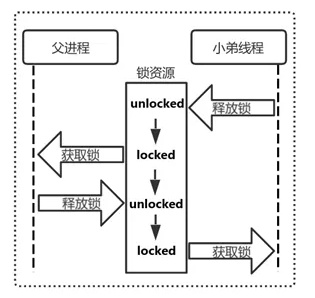
在上面的例子中,父进程通过pthread_create创建出了一个小弟sub_pthread,父进程与小弟之间配合默契,你释放锁我就获取,玩得不亦乐乎。
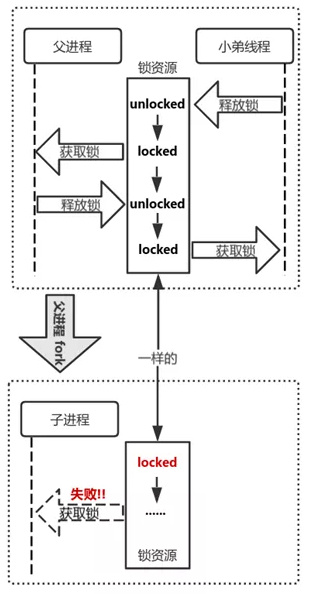
这时候,父进程生娃娃了,这个新生娃娃集成了父进程的绝大部分资源,包括了锁的状态,然而,子进程并没有共生出小弟,就是说子进程并没同时创建出子线程,他就是一个坐拥金山的孤家寡人。
所以,问题就来了。如果在父进程创建子进程的时候,父进程的锁被小弟sub_pthread占用了,fork生出来的子进程锁的状态跟父进程一样一样的,锁上了!被人占有了!因此子进程再获取锁就死锁了。
或者你会说,我在fork前获取锁,在fork后再释放锁不就好了?是的,能解决这个问题,我们自己创建的锁,所以我们知道有什么锁。
最惨的是什么呢?你根本无法知道你调用的函数是否有锁。例如常用的printf,其内部实现是有获取锁的,因此在fork出来的子进程执行exec之前,甚至都不能调用printf。
我们看看下面的示例:
#include <pthread.h>
#include <stdio.h>
#include <time.h>
#include <unistd.h>
#include <sys/types.h>
#include <sys/wait.h>

void* sub_pthread(void* arg) {
    printf("ID %d: in sub_pthread\n", getpid());
    while (1)
        printf(" \r");
    pthread_exit(0);
}

int main(int argc, char* argv[]) {
    int pid, status;
    pthread_t t1;
    pthread_create(&t1, NULL, sub_pthread, NULL);

    while (1) {
        printf("fork\n");
        if ((pid = fork()) < 0) {
            printf("fork failed\n");
        } else if (pid == 0) {
            printf("ID %d: in children\n", getpid());
            _exit(0);
        } else {
            printf("ID %d: in father\n", getpid());
            waitpid(pid, &status, 0);
            printf("ID %d exit\n", pid);
        }
    }
    return 0;
}
上面的代码主要做了两件事:
- 创建线程,循环printf打印字符’\r’
- 循环创建进程,在子进程中调用printf打印字串
由于printf的锁不可控,为了加大死锁的概率,为fork套了一层循环。执行结果怎么样呢?
fork
ID 1324998: in sub_pthread
ID 1325003: in children
ID 1324998: in father
ID 1325003 exit
fork
ID 1324998: in father
ID 1325004: in children
ID 1325004 exit
fork
ID 1324998: in father
结果在第3次fork循环的时候陷入了死锁,子进程不打印不退出,导致父进程wait一直阻塞。
上面的结果在全志嵌入式Tina Linux平台验证,比较有意思的是,同样的代码在PC上却很难复现,可能是C库的差异引起的
在fork的子进程到exec之间,只能调用异步信号安全的函数,这异步信号安全的函数就是认证过不会造成死锁的!
异步信号安全不再展开讨论,可以用man 7 signal查看,关键词async-signal-safe functions通过man 7 signal-safety查看
内核原理分析
我们知道,Linux内核中,用task_struct表示一个进程/线程,嗯,换句话说,不管是进程还是线程,在Linux内核中都是用task_struct的结构体表示。
按这个结论,我们用pthread_create创建子线程时,内核实际上是copy父进程的task_struct,创建子线程的task_struct,且让子进程task_struct与父进程task_struct共享同一套资源。
如下图
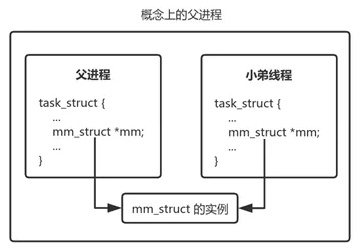
在父进程pthread_create之后,父进程和子线程组成了我们概念上的父进程。什么是概念上的父进程呢?在我们的理解中,创建的线程也是归属于父进程,这是概念上的父进程集合体,然而在Linux中,父进程和线程是独立的个体,他们有自己的调度,有自己的流程,就好像一个屋子下不同的人。
父进程fork过程,发生了什么?
跟进系统调用fork的代码:
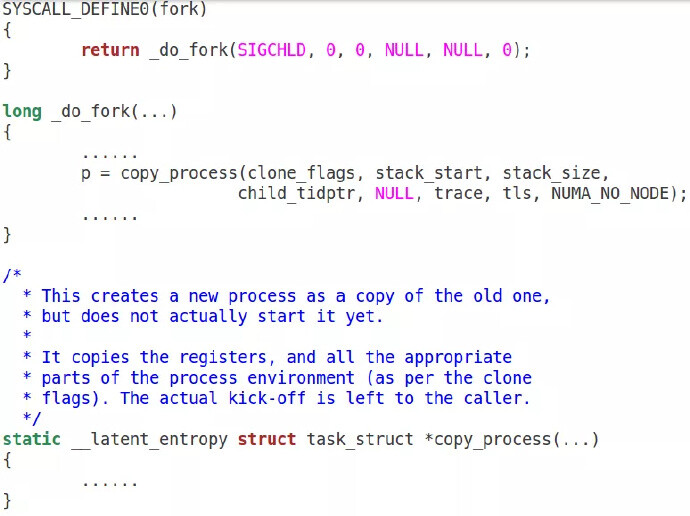
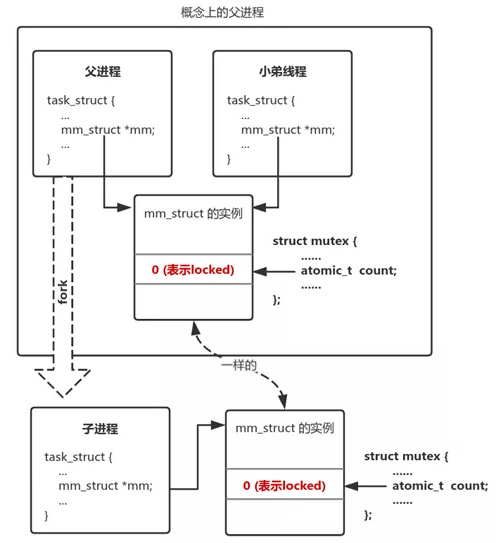
嗯…只是copy了task_struct,怪不得fork之后,子进程没有伴生子线程。所以fork之后,如下图:
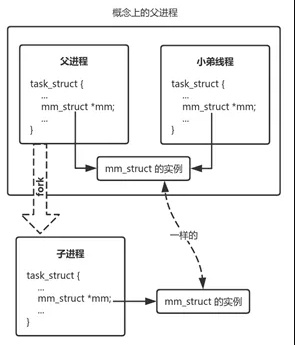
(为了方便理解,下图忽略了Linux的写时复制机制)
Linux如此fork,这与锁有什么关系呢?我们看下内核中对互斥锁的定义:
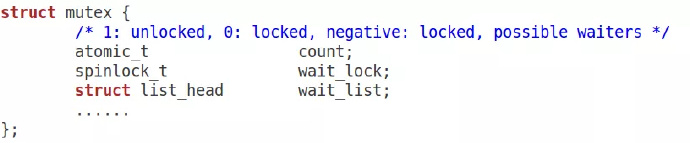
一句话概述,就是 通过原子变量标识和记录锁状态,用户空间也是一样的做法。
变量值终究是保存在内存中的,不管是保存在堆还是栈亦或其他,终究是(虚拟)内存中某一个地址存储的值。
结合Linux内核的fork流程,我们用这样一张图描述进程/线程与锁的关系: